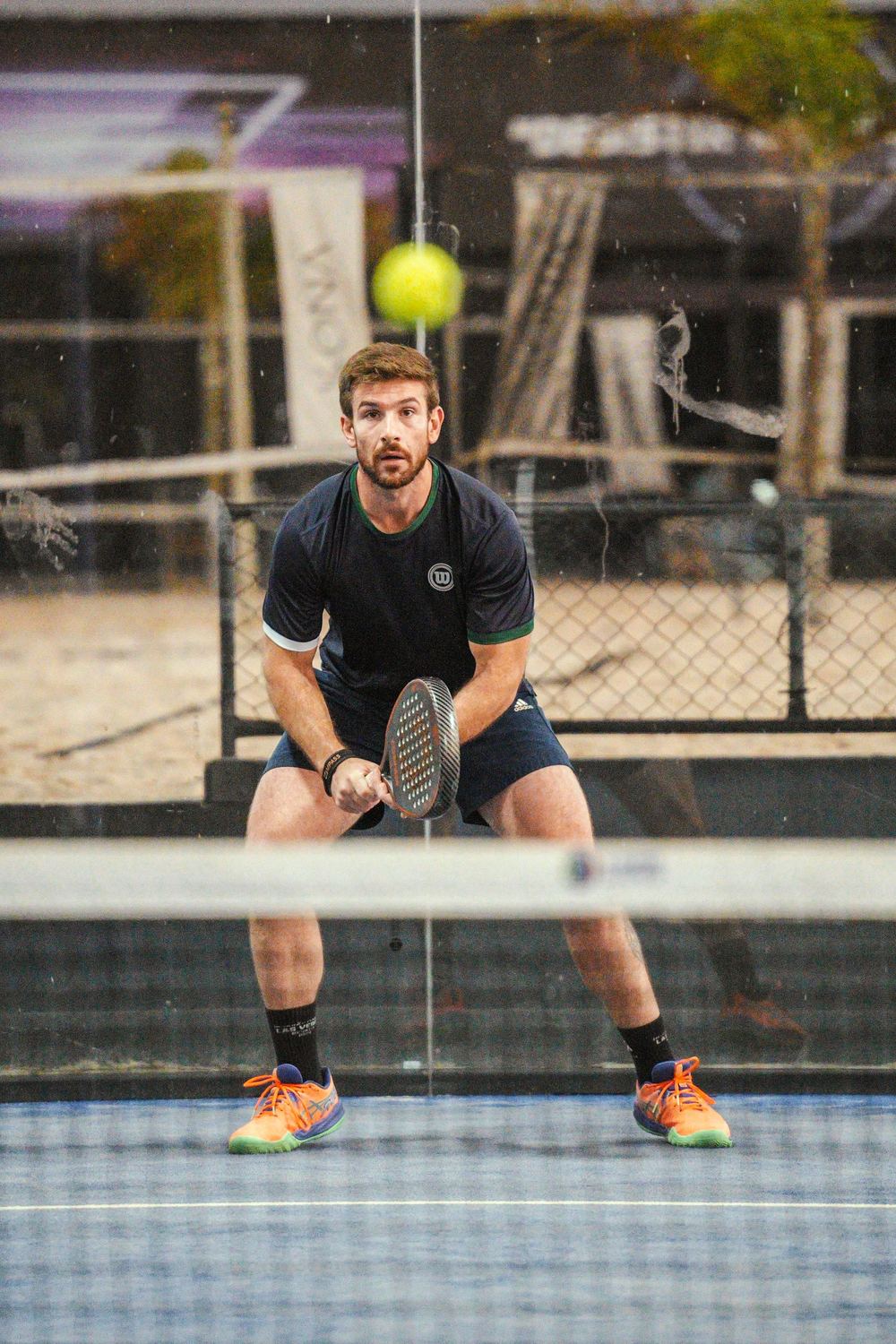
Padel is quick to learn — which is exactly why it is so popular. This guide covers the court, the gear, the rules and the scoring, plus how to get started so you play your first real match fast.
The court and the gear
A padel court is 20 by 10 metres and fully enclosed: glass back walls up to 3 metres high (often with a metre of mesh above) and metal fencing on the sides. A net of about 88 cm hangs in the middle. You always play inside the cage — and the walls are part of the game.
- Racket: solid and perforated (no strings), with a foam core. Usually weighs 360–375 grams. The shape sets its character — see the table below.
- Ball: like a tennis ball but with slightly less pressure, so it bounces a touch lower.
- Shoes: court or padel shoes with grip; outdoors on artificial turf a herringbone sole works best.
Which racket shape suits you?
| Shape | Character | For whom |
|---|---|---|
| Round | Lots of control, forgiving | Beginners |
| Teardrop | Balance of control and power | All-round / improver |
| Diamond | Maximum power, small sweet spot | Advanced attackers |
As a beginner, start with a round or teardrop shape: they forgive mishits the most.
The rules in short
Padel is almost always played two against two. The key rules:
- Serve: underhand and below waist height. Bounce the ball once behind the service line, then hit it diagonally into the service box. You get two attempts.
- Floor first: on your side the ball must hit the ground before it touches a wall. If it hits your glass or fence directly, the point goes to your opponents.
- Use your own walls: after that one bounce you may let the ball rebound off your own back or side wall and still play it back — that is the charm of padel.
- Volleys are allowed (hitting the ball out of the air), except on the serve and return, which must bounce first.
- You lose the point if the ball bounces twice, goes into the net, or is hit out of the cage.
Scoring
Scoring is the same as tennis: 15 – 30 – 40 – game, six games per set (a tiebreak to 7 at 6-6), usually best of three. At 40-40 you can play it two ways: with advantage (like tennis) or with a decisive golden point (punto de oro). The golden point is optional — it depends on what you agree beforehand or on the competition rules; the receiving pair then picks the side.
Who starts? The Spanish toss
Officially you decide who starts with a toss — a coin, or by spinning a racket and calling it before it lands. Recreationally, many players use the Spanish toss: you play one point to decide, and it only counts once all four players have hit the ball at least once. The pair that wins it chooses which team serves first (and which side).
Position and teamwork
You don't win padel at the back — you win it at the net. Whoever is there forces errors. Two golden rules:
- Move as a pair: both up or both back, never one up and one back. Slide together left and right.
- Cover the middle: most balls come through the middle — don't leave a gap there.
From the court: nine out of ten points beginners give away come from trying to hit too hard or from panicking at a ball off the glass. Calm, deep returns win almost by themselves.
How to get started — in 4 steps
Rent a racket
Don't buy straight away; almost every club rents rackets. Test what feels good in weight and shape.
Book a court
Reserve through the club or an app like Playtomic, which also matches you with players at your level.
Take a few lessons
A coach sets your grip, serve and wall play right before you learn bad habits. Many clubs run beginner clinics.
Then mostly just play
Most progress simply comes from playing; via Playtomic you quickly find players at your own level.
Common beginner mistakes
- Hitting too hard instead of placing the ball.
- Panicking at the wall — wait for the bounce.
- Drifting from your partner, leaving a gap.
- Switching grip between shots; with the continental grip you don't need to.
Reliable sources
Check the official rules at the International Padel Federation (FIP), find your national federation in the FIP federation directory, and book courts or track your level with Playtomic.
Frequently asked questions
How many people play padel?
Almost always four: two against two on a 20 by 10 metre court with glass walls.
How does scoring work?
Just like tennis: 15-30-40-game, six games per set (a tiebreak at 6-6), usually best of three. At 40-40 many competitions play a decisive 'golden point'.
How do you serve in padel?
Underhand and below waist height: bounce the ball once behind the service line and hit it diagonally into the service box. You get two attempts.
Do I need tennis experience?
No. Padel is popular precisely because you have fun quickly without experience; the underhand serve and the walls make it accessible.
What shoes do I need?
Court or padel shoes with grip. Indoors, clay/indoor soles are fine; on outdoor artificial turf a herringbone sole works best.
Can you play padel alone?
Padel is a doubles game for four people. You can practise alone against the wall, and apps like Playtomic help you find playing partners.
What is the difference between padel and tennis?
A smaller court with walls, a shorter solid racket without strings, an underhand serve and control over power. You almost always play doubles.
How long does it take to learn padel?
You learn the basics in one session. Fun, longer rallies come after a few times playing for most people.